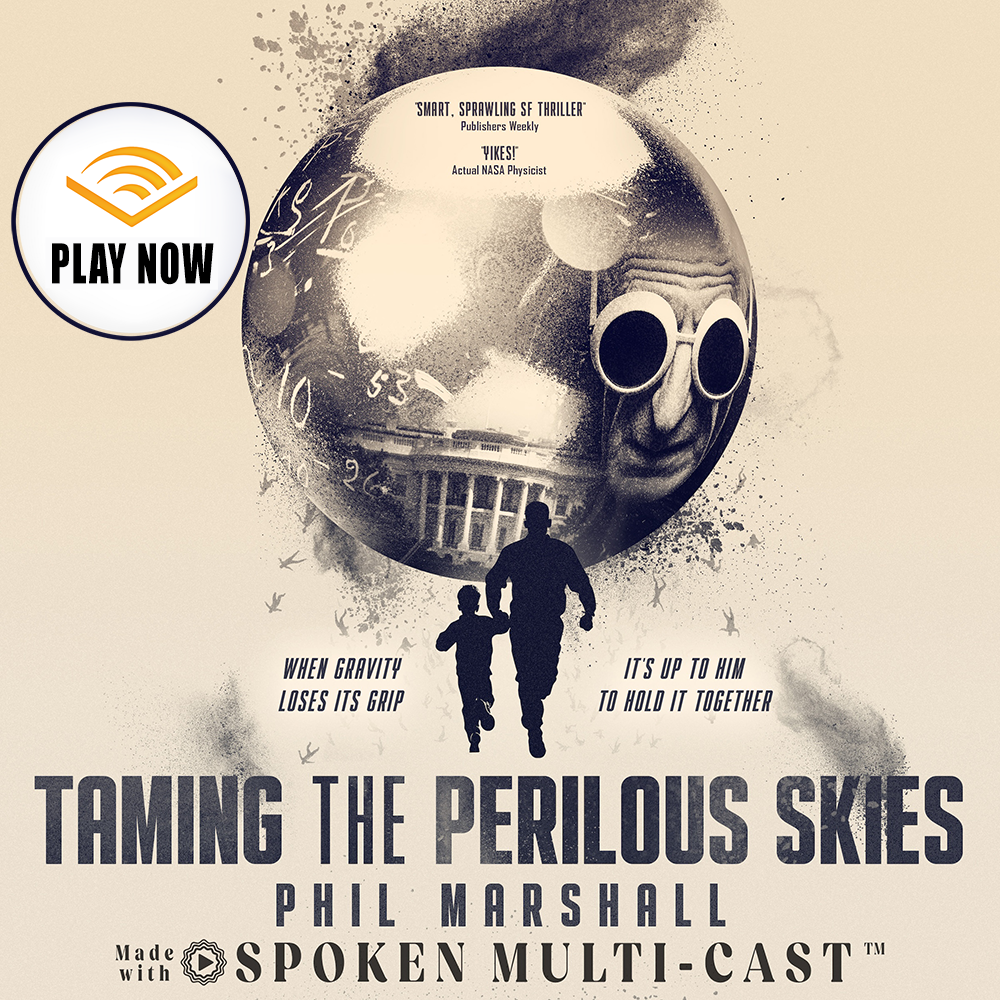
Taming the Perilous Skies
From 9/11 to today.
This is the backstory behind persistence and Taming the Perilous Skies. Twenty-five years in the thinking. Eight years in the writing.
I was on a flight that landed in Philadelphia on 9/11, in that window between when the two towers were hit. I had grabbed a Discover Magazine during my layover at O’Hare, and a 120-word sidebar by Tim Folger captivated my attention. It would ultimately change my life.
Folger described the variation of the double-slit experiment in which photons are shot at the two slits one-at-a-time. Just as if the photons had been streamed from a laser all at once, a pattern of light and dark bands materializes, indicative of classic wave interference. But how could that be if the photons were shot one-at-a-time? The prevailing explanation from quantum mechanics is called superposition. As Folger described so well, superposition holds that all particles exist in all possible places at once, and the pattern of interference comes from the particles interfering with themselves. I was baffled, and I was in good company with my skepticism. Einstein didn’t buy it either, although he was never able to pose an alternative theory that would unify his general relativity with the bizarro world of quantum mechanics.
The idea that germinated from reading that article would ultimately become my theory of persistence. If those particles each behaved as a timeless thread stretching from their origin to their termination, and if all particles that have ever or would ever exist across all time were woven together into a timeless, persistent fabric, then might the interference pattern we see building up as photons are sent one-at-a-time be caused from other particles, from other times?
It took some time – a few months as I recall – for the other shoe to drop. If all particles that have ever or will ever exist are woven into a timeless fabric, might that fabric wrap more densely around the pathways of masses, such as planets and their moons, and less densely between them? Might that create a force differential we experience as gravity? My unified theory was born.
I was trained as a scientist (physician and surgeon) but I would be a complete outsider in the world of theoretical physics. I was and am, at best, an “armchair physicist.” I knew the best way to explore the idea would be to fully understand its implications, then write an interesting story around them.
The next step in my journey was as important as that spark from the double-slit article. I do not know how Ted Chiang’s Story of Your Life wound up in my hands (or in my ears via narrator Abby Craden) but Chiang’s explanation of Fermat’s Principle cemented my belief in persistence. The path of a ray of light is the one that takes the least amount of time.
Fermat’s Principle means that every particle must know its entire trajectory from its very inception. Chiang’s intellectual masterpiece of weaving together Fermat’s Principle with the Heptapod B language, and the alien’s simultaneous notion of existence, changed my life once again. My next step was to do whatever I could to enter a writing workshop with Ted Chiang. The upcoming 2019 Utah-based Futurescapes had Ted Chiang on faculty, and I applied. Not only did I get into the weekend workshop, but into their prestigious week-long manuscript workshop as well. My first attempt at prose was in the presence of Ted Chiang (or, as my friends from that workshop call him, Ted <clinch fist and give one vigorous pump> Fucking! Chiang). Nothing could have been better.
From there, I conjured my near-future world in which the acceptance of persistence as the law of the universe had resulted in several revolutions. The first was the invention of anti-gravity, with all the ramifications you might expect. The next was the social revolution, in which free trade and travel eliminated most sociopolitical barriers. The third, and one I feature prominently in the book, is the spiritual revolution, in which organized religions around the world accept the timeless fabric as one and the same as god. Finally, there is the psychological revolution, in which our understanding of the permanence of our actions leads to a dramatic reduction in crime. These provide the utopian backdrop to my world of 2076, and to the terrible tragedy at the heart of the story.
Somewhere at the height of Covid, I realized the biggest implication of all. I knew what I had to do. I had to center that implication as the mind-bending culprit of The Fall of 2076.
On the morning of October 19th, the impossible happens: the aerial control grid fails and vehicles begin plummeting from the sky. Caught at the center of the crisis is Jack Woods – a mild-mannered safety official, single father, and reluctant hero. Alongside encryption genius Olivia Martorana and the brilliant but chaotic Medlock, Jack must decipher a mind-bending mystery spanning governments, faith, and the very fabric of time itself.
The clock is ticking. If Jack doesn’t solve the puzzle by 8:00 p.m., his son will die.
Caught at the heart of the disaster is Jack Woods – a mild-mannered safety official, single father, and reluctant hero. Jack, along with encryption genius Olivia Martorana and the irascible Medlock, uncover a conspiracy spanning religion, governments, and the fabric of time itself.
I was thrilled to share my advance reader copy at Seattle Worldcon last year, with all its bloat and imperfections. It was also there that I shared with Ted Chiang my invocation of his name with Chiang’s Postulate. I won't go further into that, lest I reveal spoilers, but I will say that Ted was at first a bit perplexed, then quite gracious about my inclusion.
Fast forward to one short year, after a full professional edit, and I was delighted to share my first official edition at LACon, available on Amazon here.
I'm really pleased with the reactions of readers so far, but it is the audiobook that is nearest and dearest to my heart. I am an inventor, an AI technologist, and an audio-only reader, and after inspiration from the incredible 2023 Taos Toolbox workshop with Nancy Kress, Walter Jon Williams, and George RR Martin, I invented Spoken. I used Spoken to narrate my story with 100 unique voices, one for each speaking character. That audiobook went live on Audible just a few days ago, and I could not be prouder of how vividly my characters bring my story to life. “This is Audible. Made with Spoken.” Those words, in succession, are the culmination of a journey, from 9/11 to today. Twenty-five years in the thinking. Eight years in the writing.
It’s available at the link below. (Oh, and I composed the theme music as well!)